Long-U2 is used after consonants that are made with the front part of the tongue.
For English, these consonants are: T / D / S / Z / L / R / TH / SH / CH / J. Some examples are: tube / duty / clue / suit / rule / enthused / June.
Sometimes this vowel sound has other spelling patterns: >> “EW”, “EU”: dew / chew / blew / flew / deuce / sleuth >> “OO”: choose / soon / zoom / shoot / loose / mood / cool
Long-U1 /yuw/
Long-U1 is used for all other contexts. That means after any consonant sound that is NOT made with the front part of the tongue.
For English, those consonants are: P / B / F / V / M / C (K) / G / H. Some examples are: pupil / bugle / fuel / music / cube / argue / huge.
In addition, “other contexts” also includes when Long-U is the first letter of a word. For example: use / union / unit.
Some alternative spellings are: >> “EW”, “IEW”, “EU”: few / mew / view / feud / eulogy / eucalyptus
NOTE—
Words with “N” are not predictable, so they need to be learned individually. When you see a new word that has “N” before Long-U, just remember to check how to say it.
Some that always use Long-U1 are: annual / continue / genuine / granule / innuendo / January / manual / manufacture / menu / minuet / monument / venue. These all sound odd if they are pronounced with Long-U2.
Some examples with Long-U2 are: avenue / manure / nuance / nude / nucleus / numeric / new / news. (Some of these can also be pronounced with Long-U1, but that makes them sound more old-style.)
Try It!
Using the patterns explained above, you now can figure out how the Long-U should be pronounced in these words, even if some of the words are unfamiliar for you. (You can find the answers are at the bottom of this post.)
In Vowel Sequences part 1 and part 2, we learned that a vowel sequence is two vowels next to each other which belong to separate syllables and both of the vowels need to have their own sound.
Vowel sequences can be tricky to pronounce clearly, unless you know the secret trick of using the end part of the first vowel as a separator for the two sounds and as a bridge for your tongue.
Many linguists call the end part of the long vowels an “off-glide”. The off-glide for Long-A, Long-E, and Long-I is a /y/ sound, and the off-glide for Long-O and Long-U is a /w/ sound.
If you find it difficult to use the off-glide between two vowels, it might help to look at some examples of words that have a visible [y] or [w] between vowels. For your tongue, the process of pronouncing vowel sequences is similar to saying these kinds of words: layer / saying / growing / vowel
So, imagine a [y] between the vowel sequences in these words: chaos / being / ion
And imagine a [w] between the vowel sequences in these words: proactive / January
Vowel sequences between words
Once you know how to correctly pronounce vowel sequences, you can use the same strategy to speak more clearly when there are two words that have adjacent vowels.
Examples:
A vowel sequence happens in the phrase “see it”. So use the /y/ part of the vowel of the first word as the bridge to the next word, so that it sounds like {see-yit}. If you do not use the /y/ part between them, then it could sound more like the word “seat” instead of “see it”.
In the phrase “go out”, use the /w/ part of the first vowel as the bridge, and say {go-wout}.
Listen for the /y/ or /w/ off-glide between the vowels as I say these phrases and sentences:
the answer: What was the answer?
we all: Do we all want the same color?
three oranges: There are three oranges left.
go on: Let’s go on the bridge.
blue icon: Click the blue icon.
who ate: Who ate my sandwich?
Learning to say vowel sequences well can make your English sound much nicer and easier to understand.
Vowel sequences are two vowels next to each other in a word, that belong to separate syllables, and each one makes its own sound. In Vowel Sequences 1, we learned that the first vowel of a sequence uses its Long-vowel sound, and we need to use the ending part of the first vowel to help establish a boundary between the two vowel sounds.
Examples:
science — The first vowel is Long-I (/ay/), so we need to use the /y/ part of that vowel as a link to the second vowel, so that it sounds like {sci-yence}.
coerces — The first vowel is Long-O (/ow/), so we use the /w/ part as the link to the second vowel, and it sounds like {co-wer-ces}.
Using the /y/ or /w/ part of the first vowel has two main advantages:
It creates a boundary between the two vowels, so that the two syllables can be clearly heard.
The vowel sequence is much easier to pronounce because the /y/ or /w/ is like a bridge for your tongue.
By the way, don’t be afraid to exaggerate the “bridge” a little bit!
In these words, the first vowel of the sequence is a Long-A, Long-E, or Long-I sound, so the bridge sound is /y/: area / aorta / client / idea / diet / giant / medium / museum / period / piano
(They sound like: {A-re-ya}, {a-YOR-ta}, {CLI-yent}, {i-DE-ya}, {DI-yet}, {GI-yant}, {ME-di-yum}, {mu-SE-yum}, {PE-ri-yod}, {pi-YA-no}. The capitalized letters show the stressed syllable.)
In these words, the first vowel of the sequence is Long-O or Long-U, so the bridge sound is /w/: cooperate / doing / fluid / fuel / oasis / ruin / situation / usual
Finally, here is an extra tricky word: “bioethics”. It has a sequence of three vowels! The first vowel is Long-I, so the /y/ part is used, and the second vowel is Long-O, so the /w/ part is used, and the word sounds like {bi-yo-WE-thics}.
When you find a new word that has two vowels next to each other, you need to check whether the two vowels make just one vowel sound together (a vowel pair), or whether they make two separate sounds (a vowel sequence).
Vowel Pair: This is when two vowels are together in a word, and together they make just one vowel sound and they belong to the same syllable. For example, in the words “rain” or “head”. (see more examples in Vowel Pairs)
Vowel Sequence: This is when two vowels are next to each other in a word, and they make two separate sounds, and belong to different syllables, as in the words “diet” or “eon”.
Vowel sequences can be tricky to pronounce, and there are many students of English who have trouble saying them clearly.
Sometimes, there are words that can be confused, if the vowel sequence is not clear. Here are some common examples:
science: The [i] and the [e] both need to be clear, otherwise this word is often confused with “signs”. coerces: If the [o] and the [er] are not both clearly pronounced, this can be confused with “courses”. create: This could sound like “crate”. quiet: This could sound like “quite”.
Even when there is not a similar sounding word, an unclear vowel sequence could make the word unclear. Here is a funny example: I once had a student who told me that when she first arrived in the U.S., she went to the store to buy deodorant, but she couldn’t buy any, because she couldn’t pronounce the word “deodorant” right, and nobody at the store understood what she wanted. She told me this story the day we were learning about vowel sequences, because suddenly she realized that her trouble with pronouncing “deodorant” was mostly about not knowing that the “eo” sequence needed to be two different vowel sounds.
So then, how do native-speakers of English pronounce vowel sequences clearly? Here is the secret…
FIRST: The first thing to know is that in a vowel sequence, the first vowel almost always has a Long-vowel sound.
SECOND: The secret key is to use the end part of the first vowel. This is where the IPA symbols are useful. When we look at the IPA symbols for the Long-vowels, and look at the 2nd part of each one, we can see a little pattern…
These have a /y/ sound at the end:
Long-A (/ay/)
Long-E (/iy/)
Long-I (/ay/)
These have a /w/ sound at the end:
Long-O (/ow/)
Long-U (/yuw/ or /uw/)
The little /y/ and /w/ parts at the end of the Long-vowels are the secret tool that you need to use to clearly pronounce vowel sequences.
The way to use them is by making them a little bit stronger than usual, so that they make a little bridge between the two vowels of the sequence.
Let’s try this with a few words:
science: The first vowel is Long-I, so the /y/ part should be pronounced a little more strongly, so that it sounds like {sci-yence}. coerces: The first vowel of the sequence is Long-O, so the /w/ part needs to be used, to make it sound like {co-werces}. create: Emphasize the /y/ part of the Long-E, to make it sound like {cre-yate} quiet: Use the /y/ ending of the Long-I to separate the two vowels, like {qui-yet}
Now you know how to more clearly say a word such as “deodorant”!
Knowing the Long-vowel sounds and Short-vowel sounds of English can help you be better at pronouncing new words and deciphering spelling patterns, but it also helps to be aware of the IPA (International Phonetic Alphabet) symbols for the vowels. Some people learn IPA symbols when they first begin to learn English, but others have never seen these symbols before. Either way, it can be useful to refer to them for some aspects of English pronunciation.
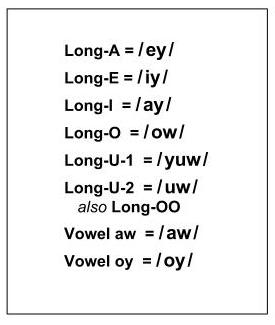
One of the main differences between Long and Short-vowels is that Long-vowels have two parts to their sound and Short-vowels have one part. In the Long-vowel IPA symbols below you can see the two parts for each Long-vowel.
Here are two situations where it is helpful to take a look at the IPA symbols of Long-vowels.
1. Vowel sequences
A vowel sequence is when there are 2 vowels next to each other, and they both have a sound, and they belong to different syllables, as in the words “idea” (3 syllables), or “fluid” (2 syllables). (NOTE: This is different from vowel pairs that belong to the same syllable and make only one sound.)
In order to pronounce both of the vowels in a sequence clearly, so that they can both be heard clearly, we need to make special use of the second part of the first vowel. Let’s see how that works with the words “idea” and “fluid”.
Idea — In this word the first vowel of the sequence is a Long-E, and the IPA symbol (/iy/) shows a “y” at the end. The trick is to use that “y” part to separate the two vowels. This is done by pronouncing it a little bit stronger than usual. This makes the word sound like it could be spelled as “ideya”.
Fluid — In this word the first vowel is a Long-U. The IPA symbol (/uw/) shows a “w” at the end. This “w” is emphasized, to make a separation between the [u] and the [i], and it sounds like “fluwid”.
2. Consonant morphing
The consonants “T”, “D”, “C”, “S”, and “Z” sometimes change their sound. Here are some examples:
“virtue” — the “T” sounds like “CH”
“educate” — the “D” sounds like “J”
“sugar” — the “S” sounds like “SH”
“social” — the “C” sounds like “SH”
This kind of consonant change can happen when the consonant is followed by a high-front vowel sound — this is seen as either a “y” or “i” in IPA symbols. In words like these, there is (or once was) either a Long-I-2 /iy/ or a Long-U-1 /yuw/ right after the morphing consonant. The consonant combines with the high-front part of the vowel sound and changes.
In some of these words, the original vowel sound is lost. For example, in “social” the [i] is lost when it combines with the [c] (the [a] remains as schwa). However, in “educate” the [d] gets changed but the Long-U can still be heard.
SO, overall, it is most helpful to know the vowel system in terms of Long and Short-vowels, because many pronunciation patterns make use of them, but also keep your eye on the IPA symbols for extra clues.






 PronunciationCoach